
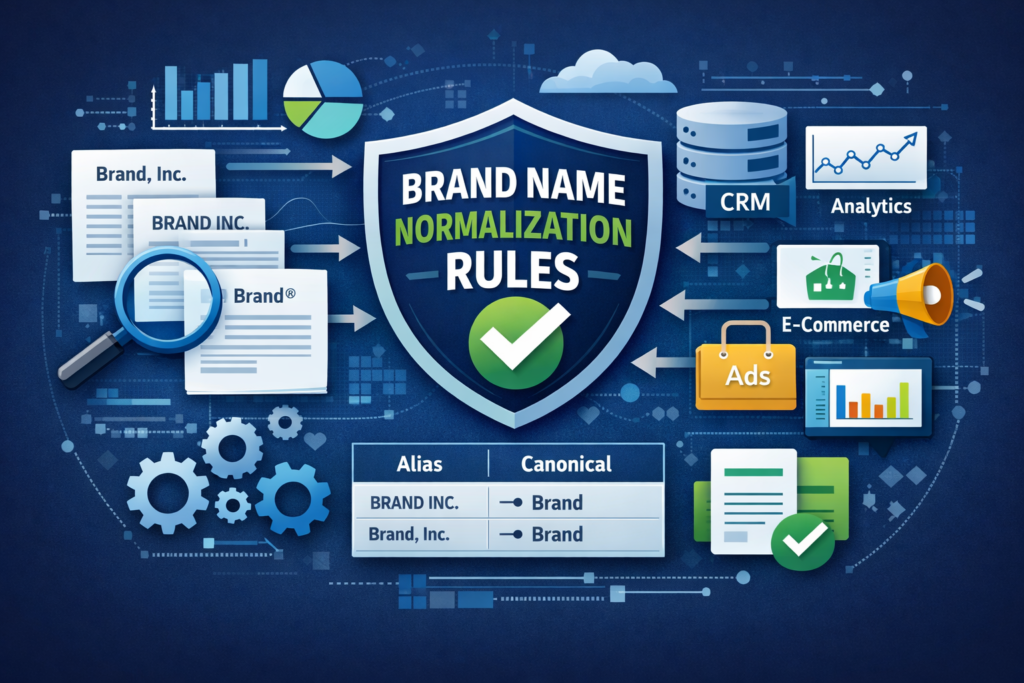

Understanding Brand Name Normalization Rules
Brand Name Normalization Rules are a structured set of standards used to ensure that brand names are recorded, stored, and displayed in a consistent and unified way across all digital and operational systems. In today’s data-driven environment, brand names appear in countless formats due to variations in spelling, capitalization, punctuation, abbreviations, legal suffixes, and regional differences. Without normalization, these variations fragment brand identity and reduce the reliability of data.
Normalization rules act as a corrective framework. They transform inconsistent brand inputs into a single, authoritative representation known as the canonical brand name. This allows businesses to treat all references to a brand as one unified entity, regardless of how the name originally appeared in raw data.
The Growing Importance of Brand Name Normalization
As organizations rely more heavily on automation, analytics, and multi-platform marketing, the importance of Brand Name Normalization Rules has increased significantly. Even minor inconsistencies can cause major downstream issues. A brand listed under multiple variations may appear as several separate entities in reports, leading to inaccurate performance metrics and flawed strategic decisions.
From an SEO perspective, inconsistent brand naming weakens topical authority and brand recognition in search engines. In customer data systems, it leads to duplicate records and incomplete customer profiles. Normalization ensures that every system speaks the same language when referring to a brand, creating clarity and trust in the data.
Defining the Canonical Brand Name
At the core of Brand Name Normalization Rules lies the concept of a canonical brand name. This is the officially approved version of the brand name that all other variations map back to. Establishing this standard is the first and most critical step in normalization.
The canonical name should reflect the brand’s recognized public identity while remaining practical for digital systems. Once defined, it becomes the anchor for all brand references. Any alternative spelling, formatting, or historical version is treated as an alias rather than a separate brand. This approach ensures long-term consistency and prevents fragmentation as new data is added.
Capitalization Standards in Brand Normalization
Capitalization inconsistencies are among the most common issues addressed by Brand Name Normalization Rules. Brand names may appear in lowercase, uppercase, or mixed case depending on the source system. Without a defined capitalization rule, systems may interpret these as different brands.
Most organizations choose title case for customer-facing content because it improves readability and professionalism. Others prefer uppercase for internal systems due to technical simplicity. The specific choice matters less than consistent enforcement. Once a capitalization standard is selected, it must be applied uniformly across all platforms and datasets.
Managing Legal Suffixes and Corporate Identifiers
Legal suffixes such as Inc., Ltd., LLC, PLC, or GmbH often appear in formal documents but create unnecessary complexity in analytics, marketing, and SEO contexts. Brand Name Normalization Rules typically specify when these suffixes should be removed.
For most operational use cases, stripping legal identifiers improves clarity and simplifies brand grouping. However, normalization rules must also recognize that legal suffixes may still be required in contracts, invoices, or compliance-related systems. A strong normalization framework clearly separates legal naming requirements from analytical and branding needs.
Handling Symbols and Trademark Indicators
Symbols such as ®, ™, and © frequently appear alongside brand names, especially in marketing content. While they serve a legal purpose, they introduce inconsistency into data systems if not handled correctly.
Brand Name Normalization Rules usually require the removal of these symbols from normalized values. This ensures cleaner matching, easier aggregation, and fewer duplicates. Trademark symbols may still be retained in creative assets, but they are excluded from canonical brand records to maintain consistency across data systems.
Standardizing Punctuation and Special Characters
Punctuation and special characters are another major source of brand inconsistency. Hyphens, apostrophes, periods, and ampersands often vary depending on user input or data source. Normalization rules define how these elements are treated to avoid duplicate brand entries.
Some organizations choose to preserve special characters exactly as they appear in the official brand name, while others standardize or replace them for simplicity. The critical factor is consistency. Once a rule is defined, it must be applied across all brand references without exception.
Spacing and Formatting Consistency
Inconsistent spacing may seem trivial, but it has a significant impact on data accuracy. Extra spaces, missing spaces, or irregular formatting can cause systems to treat identical brand names as separate entities.
Brand Name Normalization Rules address this by enforcing uniform spacing practices. Leading and trailing spaces are removed, multiple spaces are collapsed into one, and formatting is standardized according to the canonical brand name. These small adjustments play a vital role in maintaining clean, reliable brand data.
Abbreviations and Acronyms in Brand Names
Many brands are commonly referred to by abbreviations or acronyms, which can create confusion if not properly normalized. Brand Name Normalization Rules clarify whether an acronym should serve as the canonical name or be mapped to a full version.
In cases where the acronym is more widely recognized than the expanded name, it may become the official standard. In other situations, the full brand name is used, with the acronym treated as an alias. Clear rules prevent ambiguity and ensure consistent brand representation across platforms.
Language and Localization Challenges
Global brands often operate across multiple languages and regions, introducing additional complexity into normalization. Accented characters, translated names, and regional spellings can all lead to fragmentation if not addressed.
Brand Name Normalization Rules must account for localization by defining how language differences are handled. Some systems support accented characters, while others do not. Organizations must choose a consistent approach that balances technical limitations with brand authenticity, ensuring uniformity across international datasets.
Parent Brands and Sub-Brand Relationships
Large organizations frequently manage multiple sub-brands under a single parent brand. Normalization rules must define how these relationships are represented in data systems. Without clear guidelines, sub-brands may be incorrectly grouped or double-counted.
Depending on business objectives, sub-brands may be treated as independent entities or rolled up under the parent brand for reporting purposes. Brand Name Normalization Rules ensure that this structure is applied consistently, supporting accurate analysis and strategic clarity.
Alias Management and Variant Mapping
Alias management is one of the most powerful components of Brand Name Normalization Rules. It involves identifying all known variations of a brand name and mapping them to the canonical version. This includes misspellings, abbreviations, legacy names, and alternative formats.
A well-maintained alias mapping system prevents duplicates from re-entering the database and allows new data to be normalized automatically. Over time, this approach significantly improves data quality and reduces manual cleanup efforts.
Implementing Normalization Across Systems
Normalization rules are only effective when they are applied consistently across all systems. This includes customer databases, analytics platforms, content management systems, advertising tools, and e-commerce platforms. Fragmented implementation undermines the benefits of normalization.
Successful organizations document their Brand Name Normalization Rules clearly and integrate them into data workflows. Automation tools, validation checks, and governance processes help ensure ongoing compliance and prevent new inconsistencies from emerging.
The Strategic Benefits of Brand Name Normalization Rules
The long-term benefits of strong Brand Name Normalization Rules extend far beyond clean data. They enable accurate reporting, reliable analytics, stronger SEO performance, and a cohesive brand identity. Decision-makers can trust their insights because all brand references point to the same entity.
Normalization also supports scalability. As businesses grow and integrate new data sources, standardized brand naming prevents chaos and ensures continuity. This makes normalization a foundational practice rather than a one-time cleanup exercise.
Brand Name Normalization as a Data Governance Practice
Brand Name Normalization Rules are increasingly viewed as part of broader data governance strategies. They define ownership, accountability, and standards for how brand data is managed over time. This governance perspective ensures that normalization remains effective even as teams, tools, and markets evolve.
By treating brand names as governed entities rather than free-form text fields, organizations protect the integrity of their data and reinforce brand consistency at every level.
Conclusion
Brand Name Normalization Rules provide the structure needed to manage brand identity in complex digital ecosystems. By defining clear standards for capitalization, suffixes, symbols, spacing, abbreviations, and aliases, organizations eliminate inconsistency and improve data reliability.
In an environment where data accuracy drives performance, normalization is not optional. It is a strategic necessity that strengthens analytics, enhances SEO, and preserves brand clarity across every platform. Businesses that invest in strong normalization rules position themselves for scalable, data-driven success.